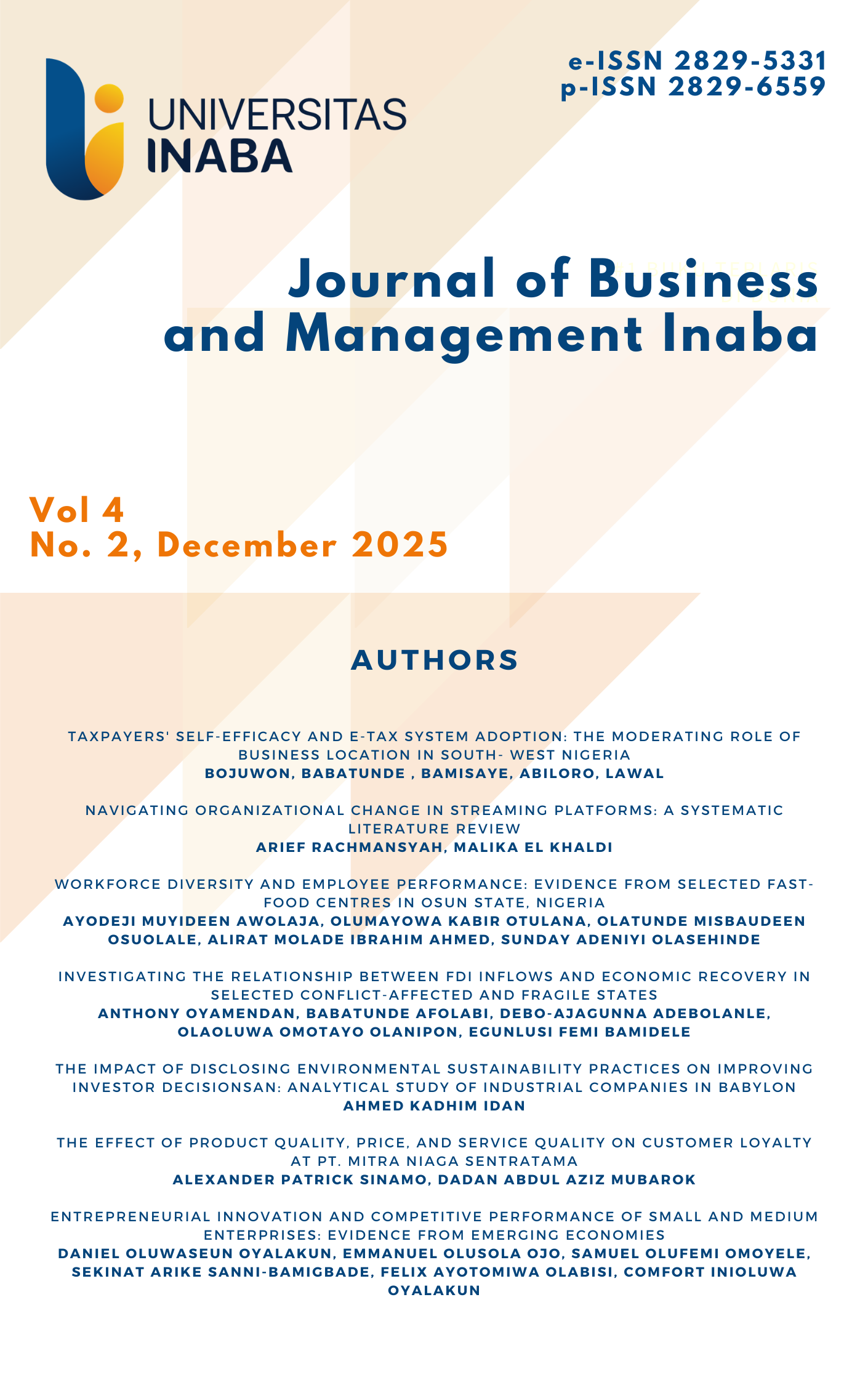
Workforce Diversity And Employee Performance: Evidence From Selected Fast-Food Centres In Osun State, Nigeria
DOI:
https://doi.org/10.56956/jbmi.v4i2.498Keywords:
workforce diversity, employee performance, inclusionAbstract
Workforce diversity has emerged as a critical element in today’s organizational landscape, particularly in service-driven industries where interactions, collaboration, and innovation are central to performance. However, managing diversity effectively remains a significant challenge, especially in developing economies such as Nigeria. This study investigates the influence of workforce diversity on employee performance in selected fast-food centres in Osun State. Adopting a quantitative research approach and a descriptive-causal comparative design, primary data were gathered through 150 structured questionnaires administered to employees, with 135 valid responses analyzed using descriptive statistics and regression analysis. Findings revealed that workforce diversity significantly predicts employee performance (R = 0.742, R² = 0.550, p < 0.05), which confirmed that diversity accounted for 55% of performance variation. Specifically, age, gender, and ethnic diversity had strong positive effects, while religious diversity showed a modest but positive influence. The findings underscore the importance of inclusive workplace practices in enhancing collaboration, efficiency, and customer satisfaction. The study recommends that fast-food organizations institutionalize diversity management policies, implement diversity awareness and sensitivity training, and adopt equitable recruitment and promotion strategies to maximize performance outcomes.
References
Agu, C.N., Ojiagu, N.C. & Nwadike, C.C., (2023). Gender diversity and creativity in Nigerian organizations: An empirical perspective. International Journal of Human Resource Studies, 13(1), 45–59.
Ali, M., Metz, I. & Kulik, C.T., (2020). The impact of diversity management on organizational performance: Evidence from global firms. International Journal of Human Resource Management, 31(7), 975–999.
Armstrong, M. & Taylor, S., (2020). Armstrong’s Handbook of Human Resource Management Practice. 15th ed. London: Kogan Page.
Barney, J., (1991). Firm resources and sustained competitive advantage. Journal of Management, 17(1), 99–120.
Cox, T.H. & Blake, S., (1991). Managing cultural diversity: Implications for organizational competitiveness. Academy of Management Executive, 5(3), 45–56.
Dessler, G., (2020). Human Resource Management. 16th ed. Harlow: Pearson Education.
Ehimare, O.A. & Ogaga-Oghene, J.O., (2019). Workforce diversity and organizational performance in Nigeria: The mediating role of inclusive HR practices. Journal of Business and Management Studies, 5(2), 112–124.
Guillaume, Y.R.F., Dawson, J.F., Otaye‐Ebede, L., Woods, S.A. & West, M.A., (2017). Harnessing demographic differences in organizations: What moderates the effects of workplace diversity? Journal of Organizational Behavior, 38(2), 276–303.
McKay, P.F. & Avery, D.R., (2015). Diversity climate in organizations: Current wisdom and domains of uncertainty. Research in Personnel and Human Resources Management, 33, 191–233.
Mande, S., Eze, B. & Okafor, C., 2020. Ethnic diversity and service delivery in African organizations. Journal of African Business, 21(3), 345–362.
Mensah, K. & Frimpong, E., (2020). Workplace diversity and employee conflict: Evidence from Ghanaian organizations. International Journal of Contemporary Management, 18(4), 220–235.
Nishii, L.H., 2018. The benefits of climate for inclusion for gender-diverse groups. Academy of Management Journal, 56(6), 1754–1774.
Nyambegera, S.M., (2019). Workforce diversity in hospitality and fast-food organizations: Implications for HR management. African Journal of Hospitality, Tourism and Leisure, 8(2), 1–12.
Ozgen, C., Nijkamp, P. & Poot, J., (2014). The impact of cultural diversity on firm innovation: Evidence from Dutch micro-data. IZA Journal of Migration, 3(1), 1–24.
Oyedele, O., Salami, A. & Fadeyi, O., (2018). Religious diversity and workplace inclusion in Nigeria: Challenges and prospects. Journal of African Management Studies, 10(2), 88–104.
Richard, O.C., Kirby, S.L. & Chadwick, K., (2013). The impact of racial and gender diversity in management on financial performance: Testing resource-based theory. Strategic Management Journal, 34(2), 161–181.
Shen, J., Chanda, A., D’Netto, B. & Monga, M., (2018). Managing diversity through human resource management: An international perspective and conceptual framework. International Journal of Human Resource Management, 20(2), 235–251.
Shore, L.M., Cleveland, J.N. & Sanchez, D., (2018). Inclusive workplaces: A review and model. Human Resource Management Review, 28(2), 176–189.
Sohail, M., Ahmad, S. & Rafiq, M., 2019. Age diversity, innovation, and team performance: Evidence from service firms. Journal of Business Diversity, 19(4), 52–66.
Tajfel, H. & Turner, J.C., (1979). An integrative theory of intergroup conflict. In W.G. Austin & S. Worchel, eds. The Social Psychology of Intergroup Relations. Monterey, CA: Brooks/Cole, 33–47.
Yamane, T., (1967). Statistics: An Introductory Analysis. 2nd ed. New York: Harper & Row.
Downloads
Published
Issue
Section
License
Copyright (c) 2025 Ayodeji Muyideen Awolaja, Olumayowa Kabir Otulana, Olatunde Misbaudeen Osuolale, Alirat Molade Ibrahim Ahmed, Sunday Adeniyi Olasehinde

This work is licensed under a Creative Commons Attribution-NoDerivatives 4.0 International License.